
What is in an EPD?
An environmental product declaration (EPD) provides a standardised, verified report on the environmental impact of a product throughout its life cycle, from raw materials extraction to product recycling or disposal.
An EPD typically includes the following core content:
Life cycle assessment (LCA) results – covering a product’s environmental impact across various stages of its life cycle, including:
● Raw material extraction and processing
● Manufacturing and production processes
● Transportation and distribution
● Use and maintenance
● End-of-life disposal or recycling
Results from LCAs give an indication of the impact of the product in terms of the factors below, among others:
● Global warming potential (greenhouse gas emissions)
● Ozone depletion potential
● Ocean acidification potential
● Eutrophication potential
● Smog formation potential
● Primary energy use
Product information – providing detailed information about the product itself, including:
● Product definition and description
● Manufacturing process
● Raw materials and material composition
● Technical data and specifications
● Intended use and application
Company and production site details – providing information about the company producing the product and the manufacturing site, such as:
● Company name and contact details
● Production site location
● Environmental management systems and certification
End of infographic
Standards and verification details – stating the standards the company adheres to, such as:
● ISO 14025 for Type III environmental declarations
● ISO 14040/14044 for life cycle assessment
● EN 15804 or ISO 21930 for construction products
● Product Category Rules (PCR) for construction products
An EPD also includes information about the third-party verification process and the independent verifier. This is because EPDs require transparency and verified data, through independent third-party verification to ensure credibility.
This process assesses LCA adherence to PCRs and overall data quality. EPDs aim to offer accessible information for stakeholders like consumers, businesses and policymakers, helping informed decision-making. They typically use standardised formats for easy product comparison
The stages of a life cycle assessment
In an EPD, the life cycle stages of a product are identified with codes (eg: A1, A2… D). These stages provide a comprehensive framework for assessing and reporting the environmental impacts of products throughout their entire life cycle, from raw material extraction to end-of-life disposal and beyond.
This structured approach ensures consistency and comparability in EPDs across different products and industries.
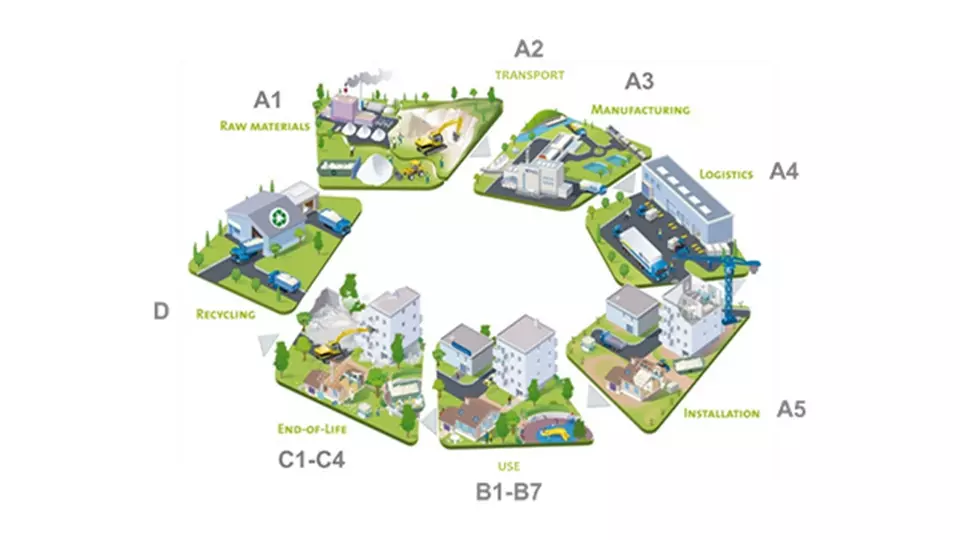
A – Product and construction stage
● A1 – Raw materials: The extraction and processing of all raw materials and their packaging, which occur upstream of the manufacturing site
● A2 – Transport: The transport of raw materials and their packaging to the manufacturer. This includes the impacts associated with fuel use and emissions from transport vehicles
● A3 – Manufacturing: The manufacturing processes that convert raw materials into finished products, including packaging. This includes energy use, water use, emissions and waste generated during production
A – Construction stage
● A4 – Logistics: Transport to the construction or installation site
● A5 – Processes: The installation of the product into the building or construction, the manufacture and transportation of ancillary materials and any energy- or water use required for the installation. Also, the surplus of raw materials and packaging acquired to compensate for the loss of product during the installation and the transport and management of packaging and product waste
B – Use stage
● B1 – Use: Use of the installed product, including the consumption of materials and any direct emissions or environmental impacts during its use phase
● B2 – Maintenance: The activities required to maintain the product’s functionality, including cleaning, repairing and replacing parts
● B3 – Repair: The specific activities related to fixing any defects or damage that occurs during the product’s use
● B4 – Replacement: Replacement of parts during its lifetime
● B5 – Refurbishment: The refurbishment activities that extend the product’s life or improve its performance
● B6 – Operational energy use: The energy consumed by the product during its use (applicable to products requiring energy to function)
● B7 – Operational water consumption: Water consumed by the product during its use phase (applicable to products that use water)
C – End-of-life stage
● C1 – Deconstruction and demolition: The technical operation for deconstruction and/or dismantling the product at the end of its life
● C2 – Transport of waste: The transportation of the product after its use to recycling, recovery or disposal sites
● C3 – Waste processing for reuse, energy recovery and/or recycling: The collection of waste from the deconstruction and/or dismantling and the processing of material, such as sorting, shredding or compacting, that prepare the product for recycling or disposal
● C4 – Disposal: The final disposal of the product, including landfill, incineration or other disposal methods
D – Recycling, reuse or recovery
Potential benefits and loads from recycling, reuse or recovery of materials after the end-of-life stage. This includes the environmental impacts avoided by diverting waste from disposal and reusing materials in new products.
Why is it important for Saint-Gobain to have EPDs?
EPDs provide with better knowledge of its environmental impact. Because they are standardised, they allow us to more easily compare two or more solutions than would be the case without standardised reporting parameters.
Also, EPDs allow Saint-Gobain to communicate on our environmental performance. This is important to us – at Saint-Gobain, we want to be the worldwide leader in lightweight and sustainable construction and have set ourselves ambitious environmental goals for 2030 and 2050.
EPDs incorporate life cycle assessments (LCAs), which help Saint-Gobain to enhance innovation and improve sustainability performance across our operations. The company uses LCAs as a critical analytical tool to make cradle-to-grave assessments that help us evaluate the environmental impacts associated with our products throughout their entire life cycle.
Communication and transparency: EPDs allow us to disclose the environmental impact of our products in a clear, standardised way. This transparency enhances our credibility and builds trust with our customers, stakeholders and regulatory bodies.
Market requirements: In a market where environmental awareness is increasingly important, EPDs allow us to demonstrate our commitment to sustainable development, and to environmentally conscious customers.
Regulatory compliance: Producing EPDs helps us stay ahead of various regulatory requirements in the jurisdictions in which we operate, reducing the risk of non-compliance. Also, EPDs can qualify us for various green building certifications and incentives, such as Leadership in Energy and Environmental Design (LEED).
Continuous improvement: Understanding the life cycle environmental impacts of our products also allows us to identify areas for improvement in our supply chain, or to identify and mitigate environmental risks associated with our products.
Innovation: The EPD development process pushes us to innovate. It highlights areas where we can improve our environmental performance, leading to the creation of more sustainable products and processes.
By producing EPDs, we reaffirm our commitment to sustainable practices, transparency and continuous improvement, ensuring that we not only meet, but exceed the expectations of our customers and stakeholders.